ES
ES  IT
IT 
 ES
ES  IT
IT The BTS No strategy is one of the techniques I use most in sports trading on football. BTS No stands for Both Teams to Score No, also known as No Goal. Unlike many strategies, it offers greater live flexibility that allows you to close in profit in numerous situations. This strategy is very defensive and can be applied to many matches.
In this complete guide we analyse how the BTS No market works, how it differs from Under 2.5, and how to select the right matches to manage risk.
What is the BTS No Market and How Does It Work
The BTS No market (Both Teams to Score No) wins whenever only one of the two teams scores, or neither team scores at all. The loss condition only occurs if both teams manage to score at least one goal during the match.
Winning and Losing Results
One team scores, or neither
The bet wins in all these scenarios
Both teams score
One goal each is enough to make the bet a loser
This mechanism makes BTS No particularly suited to matches with a clear favourite. If the favourite scores 2 or 3 goals, the bet remains winning as long as the weaker team fails to score.
BTS No vs Under 2.5: Why It Is Superior for Live Management
The comparison with Under 2.5 is essential to understand the real advantage of BTS No. Both strategies target low-scoring matches, but they behave very differently when the favourite takes control of the game.
BTS No Advantages
A comparison of the two markets highlighting the advantages of No Goal.
Profit even with 3 goals from the favourite
If the strong team goes 3-0, you are already likely in profit. With Under 2.5 you would be losing at the third goal.
Key advantageStep-by-step green up
You can close part of the position in profit during the match, for example before half-time.
Live flexibilityProtection in more situations
The bet protects itself in one-sided matches. The more the favourite dominates, the safer you are.
Natural protectionLost at the third goal
With Under 2.5 you lose as soon as the third goal arrives, regardless of who scores.
Critical limit2-0 lead = danger
If the favourite goes 2-0, you are already losing with Under 2.5. With BTS No you would likely be in profit (depending on when they scored).
Worst scenarioUseful for balanced matches
Under 2.5 works better in very balanced matches where a dominant performance is not expected.
Specific contextHere is what happens in a typical scenario: the favourite leads 2-0 at the 30th minute.
- ✓
BTS No: you are in profit
At 2-0 the BTS No market drops in odds. In most cases you can already green up and cash in. There are more advanced management approaches.
- ✗
Under 2.5: you are in danger
At 2-0 you only need one more goal to lose everything. The Under 2.5 odds rise significantly and you are in red.
Key Criteria for Selecting BTS No Matches
Match selection is the determining factor for the BTS No strategy. A wrong choice can nullify any optimal live management. The criteria below are the result of years of activity in the markets.
The 4 Essential Requirements
- 1
Clear favourite with a solid defence
The favourite must concede few goals and have a strong defence. Being the favourite alone is not enough: they must rarely give chances to the opponent. You must choose teams with high clean sheet values.
- 2
Large gap between the two teams
A significant difference in values is required. Matches where both teams score easily must be categorically avoided.
- 3
Underdog that rarely scores in the first half
If the underdog's goals tend to arrive in the second half of the match, you have more time to exit in profit when trading on the exchange.
- 4
Top teams in leading positions in major leagues, cup quarter-finals, semi-finals, finals
High-level clashes with teams at the top of the table, or important cup ties where something significant is at stake, are optimal. "Important" matches where something meaningful is on the line lead teams to play with more caution and take fewer risks.
The Ideal Entry Odds
Not all BTS No markets are equal. The opening odds are a key signal to evaluate before entering.
In this range the market offers the best balance between risk and return. Below 1.70 the margin is too thin; above 2.50 the market expects more goals. It is important to know that bookmakers do not price this type of market well. Mispriced No Goal odds are common. Statistics and match importance must be carefully analysed, and market entry should be considered accordingly. If in the opening minutes both teams are clearly pressing hard, a cash out can be taken.
When High Odds Become an Opportunity
The market often misprices BTS No. Opening odds between 2.50 and 2.80 indicate high goal expectations. These odds can represent the best opportunities, provided the match selection criteria are strictly followed.
Market inefficiencies on BTS No odds frequently exist, especially in matches from minor leagues. This creates short-term profit opportunities.
Operational Management: Pre-Match, Live and Weak Points
We examine when it is most convenient to enter the No Goal market.
Pre-Match or Live Entry?
BTS No can be set up both before the match starts and during the game. The choice significantly affects operations and risk control.
Advantages of pre-match entry
At market opening the odds tend to drop quickly. Entering pre-match guarantees finding the best odds before liquidity shrinks and the spread widens. It is the recommended mode for those wanting to optimise the risk/return ratio. Pre-match entry is mandatory for secondary markets because the low liquidity available widens the back/lay spread. As soon as the market goes live the spread widens: you enter 4-8 ticks worse than pre-match. The weak point is an early goal right at kick-off caused by distraction or unfocused players.
Choosing pre-match entry without live management is equivalent to accepting the result at full time, like a regular bettor. This significantly increases loss exposure and reduces the advantages of trading.
Live management: the heart of the strategy
Live management is what distinguishes the professional trader from the bettor. Live trading allows reacting to match developments in real time: exiting with a partial green up, waiting for a favourable moment, or limiting losses when the match goes against you.
Even a perfectly selected pre-match game can start badly in the opening minutes. Live management is the only tool that allows limiting the damage in these scenarios.
The recommended method: pre-match entry + active live management
The optimal combination is to enter pre-match to get the highest odds and then actively manage the position during the match. This approach combines the advantages of both modes: optimal entry odds and maximum operational flexibility.
- 1
Pre-match entry
Place the BTS No bet at a higher and more favourable odds.
- 2
Observation of the first 10-15 minutes
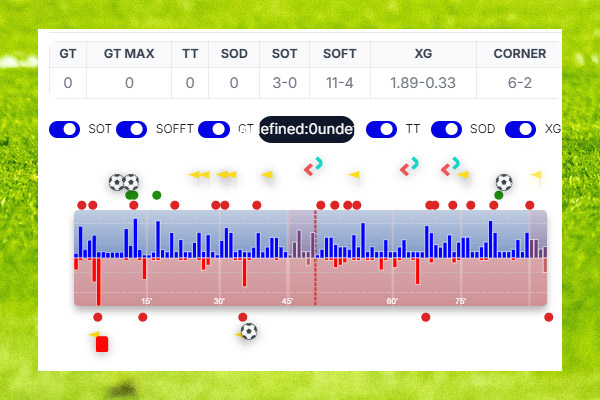
Monitor the match to assess whether the game is following pre-match expectations. Use the ScoreTrend charts and indicators for this purpose.
- 3
Step-by-step green up
Manage a gradual and intelligent exit from the market to minimise risk.
The weak point: the underdog scoring early
Every strategy has its worst-case scenario. For BTS No, maximum risk occurs when the underdog scores in the opening minutes of the match.
If the heavy underdog scores in the first 10-20 minutes, the BTS No odds can rise from 2.04 to 7/8, because the market anticipates the favourite's equaliser. In this case the loss on stake can reach 70-80%.
How to handle an immediate underdog goal
Do not react impulsively. If the underdog holds the lead until the end of the first half, the loss progressively reduces — from the initial 70-80% to around 35-40% — making the decision more manageable: either exit with a partial red or wait for further developments.
Scenario A — Favourite scores early
The BTS No odds remain stable or rise slightly. Watch the match on TV or via the bar charts and wait for the odds to drop.
Ideal situationScenario B — Balanced match
The odds first stay stable then begin to fall. Monitor the match and exit in steps. Time works in your favour.
WaitScenario C — Underdog leads
The odds rise. Do not exit immediately: watch the match and evaluate a red exit if the favourite attacks. Otherwise stay and manage the position.
How ScoreTrend Enhances the BTS No Strategy
Selecting BTS No matches relies on precise data: historical percentages, defensive trends, timing of goals scored or conceded. ScoreTrend's proprietary indicators come into play, offering an edge that goes beyond the standard statistics available to everyone.
Goal Trend
Identifies the probability that one of the two teams may score. When the value rises above 80 and both teams are attacking, you should exit.
SOD
Shows what is happening throughout the match. If low and below 3.5, you can decide to stay with BTS No. If high, better to exit as it is a very competitive match.
xTrend
As it approaches 1, it indicates a goal is possible. Based on the quality of players' shots.
Analysis«The difference between a profitable BTS No trade and a losing one lies in how the live position is managed.»
— Gianluca Landi, bettingexchange.netBTS No Strategy Video Guide
The BTS No Strategy: Advantages, Limits and Correct Approach
BTS No is one of the most complete strategies in betting exchange, because it combines live flexibility and protection in one-sided matches. Its strength over Under 2.5 is the ability to be in profit even when the favourite scores several goals.
The weak point is an immediate goal from the underdog in the opening minutes, which can create a loss of 70-80% of the stake.
Select matches carefully, enter pre-match at the best odds, manage the position actively live.

Gianluca Landi
Professional Sports Trader | Founder of ScoreTrend
Sports trader since 2007 and online with the first sports trading site and courses since 2011. Engineer specialized in data analysis and betting exchange strategies. Amazon bestselling author and founder of ScoreTrend, the leading platform for match trading and betting with proprietary indicators such as xTrend, Goal Trend, SOD, and Draw Balance.